OFFER: A BRAND NEW SERIES AND 2 FREEBIES FOR YOU!
Grab my new series, "Whispers of the Western Wind", and get 2 FREE novels as a gift! Have a look here!
 Chapter One
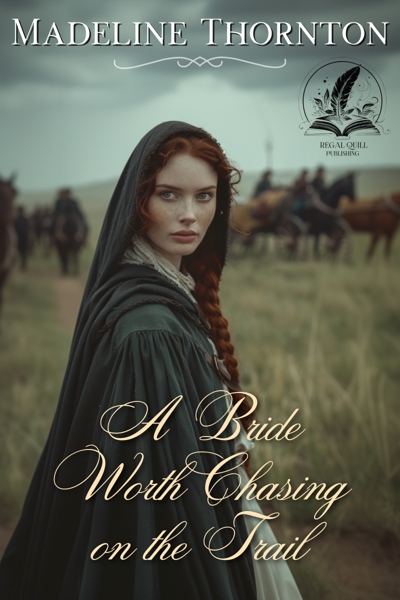
She crouched in the shadow of the brick wall, her heart fluttering so wildly in her chest that it felt like it might break the bars of her ribs and fly away. She feared that the man on the other side could hear it. It was certainly deafening to her ears, even though she had covered her mouth and nose with her hands, fighting to stifle the heavy rasp of her breathing.
The man was Jeremiah, the gardener. In daylight, he was a tall, thin, easy-going figure, his smile as brilliant in his weather-worn face as a shaft of sunlight. But that night, with his coat whipping in the wind and his lantern held high above his head, he was a sinister shadow stalking across the grassy pasture. His coonhound strained at the leash, sniffing violently, tail wagging high.
“What was that, old boy?” Jeremiah rasped.
She wanted to squeeze her eyes shut, as if that could serve to hide her better. Instead, she pressed closer against the brick wall, wedging herself between the wall and the row of old elm trees planted alongside it.
Jeremiah swung his lantern left and right. The golden light fell around her, parting around the trunks of the elms, but couldn’t quite reach her.
The coonhound must have recognized her scent. He relaxed, tail hanging, and started to sniff in other directions instead.
“Must’ve been a shadow,” said Jeremiah.
He turned away, his coat rustling and strode back toward the house and stables.
Even when her knees began to cramp, she didn’t try to move until she was certain Jeremiah and his dog were back inside. When she did rise, her limbs trembled, and she couldn’t tell whether that was from exhaustion or terror.
She had known Jeremiah all her life and she felt her throat tighten at the thought that she would never see him again.
But the afternoon’s events had driven her to doing it, and she could not turn back. No amount of the unknown could ever be as terrifying as the fate that awaited her if she stayed.
She sensed danger in the cold blue eyes of the man who had come to see her stepfather that afternoon.
She reached up, searching for handholds between the bricks and found them easily. Her dress scraped the wall as she scrambled up, petticoats rustling. Finally, she reached the top, threw a foot over the wall, and fell down the other side.
Her knees met grass with a jarring thump. She stumbled as she stood upright, scooping up the leather satchel she’d brought from the house, and clutched it close to her chest as she hurried into the street.
Someone’s dog was barking. She could only hope it wasn’t at her. Should she run, or just walk quickly? Would anyone notice her?
She decided to walk, her hands shaking around her bag as the dog’s barking receded into the distance.
There was no one there. The buildings around St Louis were run-down, extending on either side of the river; the wealthy, like her grandfather when he first arrived, had chosen higher ground away from the squalor of the docks. The city’s edge was not far from the back wall of her family’s property. Prairie grass grew between the ruts in the dirt road. It didn’t take her long to leave the brick walls and wooden fences of the houses behind and wander into the stillness of the farms. The only ones who watched her go were the horses and cows grazing in the fields, who barely bothered to raise their heads and twitch their ears as she passed.
Something howled in the night. She stumbled to a halt and listened, trembling. Wolves? Surely not. Coyotes, perhaps.
Nothing was more terrifying than the predator she had met in the parlor earlier that afternoon.
She kept walking, but the memory followed her like a shadow, clinging to her with every step.
When her stepfather summoned her to the parlor, the first thing she saw was not the damask sofa, the layered drapes, the tasseled piano cover or the pier table—all the evidence that Silas Ashford liked to display of his wealth. Instead, her gaze went straight to the man sitting on one of the stiff-backed chairs, facing Silas, a coffee cup delicately in his hand.
His hands were massive, dwarfing the cup. Despite his chiseled features and the elegant figure he cut in his beautiful black suit, there was something brutal and unrefined about his hands, something meaty. When she looked into his piercing blue eyes, she saw that same monstrousness there. His gaze swept over her, assessing her in one glance. Penetrating her with it.
The look was so intense that she stumbled to a halt in the doorway.
“Come in, come in,” Silas commanded. “Where are your manners?”
She shuffled into the room and curtseyed politely to their visitor. “Good evening. Good evening, Stepfather.”
“Pleased to make your acquaintance.” The man stood and half-bowed. “Harlan Crowe, at your service.”
“Sit,” said Silas, but he wasn’t looking at her; instead, he kept his focus on their visitor. He was a short man, appearing even smaller compared to Harlan, and his rounded shoulders made him shrink beneath his sharp gaze.
Harlan Crowe watched her as she assumed her seat. His eyes never left her, burning her skin.
She settled in a chair and arranged her hands demurely over her knees. Silas’ gaze flickered from her to Harlan and back.
“I have good news for you,” said Silas after a few fluttering seconds of silence.
She politely smiled and waited.
“Mr. Crowe here,” said Silas, “is your future husband.”
The world stumbled. She grabbed the arms of her chair to keep from falling out of it. Only years of long practice, of keeping silent, of hiding every thought and feeling, kept her from screaming, “What?”
Instead, she managed to say, “Excuse me?”
Harlan Crowe smiled. It was toothy; hungry. “It must come as a wonderful shock. You do recognize me, do you not?”
She opened and shut her mouth a few times, trying frantically to place him. Well-dressed men with cold eyes were everywhere in her life as she drifted from one gathering to the next on the arm of her stepfather, always silent, always smiling. He must have been one of the wealthy men Silas was always introducing her to… but she had never thought of him as a suitor. He wasso old.
“Indeed, I do, sir,” she said, her voice steady. “I beg pardon for my reaction. I was merely… surprised.”
“It is most understandable, my dear girl. Few would presume to expect an opportunity such as this around the corner, wouldn’t they? Well, Mr. Ashford, I will leave the bulk of the arrangements to you. I expect to see the notice in the paper tomorrow morning.”
“Very well,” said Silas. He smiled, a genuine smile, for once. His shoulders seemed to rise a little. “The wedding will be in the fall, then.”
“Of course. An excellent time. Most respectable.” Mr. Crowe rose from his seat. “I have pressing business to attend to, so please excuse me. I look forward to seeing you again soon.” His smile grew.
She stared silently up at him, as trapped as a mouse in the claws of a lazy, playful cat.
The maid showed Mr. Crowe to the door, and she flew from her seat as soon as he had left the parlor. “Stepfather!”
“Don’t take that tone with me, young lady,” Silas barked.
“But—but he—you never told me!”
“Why should I tell you? There is no questioning this. You will marry Harlan Crowe in the fall and you will do so with a smile on your face. Don’t you understand?”
She gulped, her mouth dry as paper. “I understand he’s wealthy and powerful.”
“Wealthy! He secures our future. And with him as my son-in-law…”
“He’s hardly two years younger than you, Stepfather!”
“That will not change the affiliation, nor its effects on my political career.”
She stared at him, her hands hanging limp by her sides, her heart colliding with her ribs. “Please. Please… did you see his eyes? I can’t marry him.”
“You can and you will. It is your duty. More than that, it is what you owe me.”
Her heart quailed.
“I took you in after your mother died.” Silas’ lips turned down as bitterness clouded his eyes. “Even though everything you did, every word you spoke, reminded me of my sweet wife, I allowed you to stay. I fed you, kept a roof over your head, and provided you with an education.”
Her hands balled into fists. She forced them to uncurl, forced down the pent-up tension that had been swelling in her chest since she was a child. Since the first moment she had been told that little girls were to be seen and not heard.
“I gave you a life,” said Silas. “It is time for you to repay me, girl. I expect your loyalty. This marriage will be no great hardship to you. Mr. Crowe is far wealthier than I; you will live in the lap of luxury and want for nothing.”
A thousand protests rushed to her mind. His age, his strangeness—and those brutish hands. She pictured them touching her body, and the thought made her shudder to her core.
She wanted to scream, but she had been taught to be silent. So, she begged instead. “Stepfather, please. Please…”
“I won’t hear any more of this.” He held up a hand, silencing her. “You are marrying Harlan Crowe in the fall, and that’s that.”
With that, he turned and stalked from the room. And late that night, she rose, dressed herself with difficulty, stole a few dollars from the desk in Silas’ study, and fled.
***
It was the stolen money that bothered her the most. The coins jungled quietly in her satchel as she followed the dirt road’s curve, each one an accusation. She had no choice, but no matter how she tried to rationalize taking them, she knew that it was theft.
The night air was warm and damp—sticky. She was sweating when she reached her destination: The stagecoach office at the end of the road, surrounded by stables, sweating and stamping horses, and swearing men.
She breathed a sigh of relief at the sight of the lanternlight pouring from the windows and the horses standing harnessed in the yard, buckles jingling and shoes clacking as they moved. She’d feared it would be closed.
Picking her way across the muddy, rutted road toward the buildings, she dodged around the coach standing in the yard, several men swarming over the horses as they harnessed a fresh team. A handful of travelers hoisted their baggage from the coach, all looking worn and tired and pale. Every man in the yard watched her as she crossed toward the tiny building to one side of the stables, which served as a ticket office. She felt their eyes on her like snakes on her skin.
Trying to be calm, she strode up to the counter and asked to buy a ticket.
The clerk behind the counter looked as tired as the travelers. He leaned on his ledger and eyed her over smudged glasses. “Yes, well, I didn’t think you were here to buy a sheep, darlin’,” he drawled. “Where do you want to go?”
The thought hadn’t yet entered her mind. She’d been so occupied with what she was running from that she had no idea where she was running to. “Um—where does this stage go?”
“Everywhere, darlin’. Anywhere East you like. If it’s West you want, well, we go as far as Independence.”
West. Some would consider St. Louis the frontier, like Silas’ stroppy old aunt from Boston. But there were wilder places than that, she realized. Places far away across the prairie, so distant they may as well be another world. Places where no one would ever find her.
She pulled the dollars from her satchel. Independence, she thought. The name had a poetic ring to it.
“Independence would be a good start,” she said.
The clerk took her money without interest and wrote down the sum in his ledger. “Name?”
She hesitated. Would Silas come after me? She remembered Mr. Crowe’s eyes and feared him far more.
“Laura,” she said, after some hesitation. “Laura, um, Laura Hart.”
“Laura Hart.” The clerk handed her a ticket. “Better hurry. Stage is about to leave.”
She turned and ran to the coach as the fresh horses tossed their heads and jerked at their harnesses. The driver barely glanced at her ticket, then jerked a thumb at the coach. Laura scrambled into it and found herself sandwiched between other passengers: a voluminously fat man who snored drunkenly on one side, and a bony old woman with an iron glare on the other.
Laura hugged her satchel on her lap as the stagecoach rattled away, hooves beating on the gravel road. A few minutes later, they had left St. Louis behind.
Chapter Two
The weariness left Beck Wilder’s bones the moment he saw the streak of smoke rising from the prairie.
He straightened in the driver’s seat, gripping the reins of his wagon team. “Whoa, whoa.”
The two big bay horses plodded to a halt and drooped on either side of the wagon’s tongue, as tired as their driver. Long-dried sweat lay stiff and white against their harnesses. They were nearly home, and a moment earlier, Beck’s only thoughts had been of unhitching the horses and bedding them in golden straw before he put his own feet up before the fire and enjoyed a bowl of his sister’s stew.
Then he saw the smoke. And only one, terrifying thought could occupy his mind.
Is that smoke coming from our house?
Independence, Missouri was not a large town. The few squares of wooden buildings resting among the prairie held only a couple of thousand people most of the year. Even in spring outfitting season, the sprawl of encamped wagons around the place still made it seem all the lonelier amid its prairie surroundings.
From the hill overlooking town, Beck could usually pick out his family home. Knowing he couldn’t see it was worrisome.
The fear paralyzed him for a second. Then he raised his hands and slapped the reins on his horses’ backs.
“Hyah!”
Used to gentle handling, the horses threw their heads up, startled.
“Go, ladies!” Beck shouted. “Go!”
With snorts of alarm, the horses bolted, and the wagon lurched after them.
Beck leaned forward on the driver’s seat, the reins taut as he fought to control the two horses and the heavy wagon careening behind them.
“Look out!” he shouted. “Look out!”
People and chickens scattered as the wagon thundered down the street, spraying sheets of mud onto the boardwalks. Beck looked neither left nor right, driving the horses on, his eyes fixed on the smoke.
He wrenched the reins to the left. The horses wheeled hard onto his sister’s street, bless them, galloping between the little homesteads, and Beck saw that his worst fear was true.
The blazing house was theirs.
“Whoa!” He grabbed the brake and pulled back, tugging the reins in his free hand. “Whoa!”
The horses skidded to a halt, tossing their heads, their eyes rolling white and wild with fear. Beck flung himself from the driver’s seat and ran toward the house. It was at the end of the little road, a cozy cottage containing three small bedrooms clustered around the kitchen that was its heart, with a barn on one side and Beck’s carpentry workshop on the other.
And everything had burned.
Leaping tongues of yellow flame had engulfed both stories of the house. Black smoke rolled through the workshop and barn; already, a great chunk of the workshop’s roof had fallen in, and red fire roared through the gap.
A bucket chain worked to throw water on the flames, but the attempts seemed feeble and pointless in the face of the roaring blaze.
“Mara!” Beck cried.
Men were leading cattle and horses from the barn, but Beck had his eyes glued on the house. The front door was gone; the gaping doorway revealed a raging inferno within.
Beck charged toward it. “Mara!”
“Beck, no!” Someone grabbed his arm—a neighbor, Mr. Willow, his beard and mustache singed and blackened.
“Let me go!” Beck wrenched away from him. “Mara! Lucy!”
“Beck!” Mr. Willow grabbed his shoulders. “They’re here. They’re over here, and they need you.”
Beck spun around, breathing hard, and there they were: his younger sister and her five-year-old daughter, sitting together on the porch of the house opposite theirs, clinging to each other.
Relief weakened his knees. “Mara,” he gasped.
He ran across the road to them, arms outstretched. Mara’s face was black with soot, her clothes torn, pink strips of burned flesh showing through the holes. Her tears had washed two trails down her cheeks.
“Beck,” she croaked, holding out an arm.
Beck flung his arms around her, squashing the little girl between them. Lucy clung to the front of her mother’s dress, crying hysterically, but not a hair of her angelic golden curls appeared to have been touched by flame.
“Are you all right?” Beck cried. “Are you hurt?”
“He’s dead, Beck,” Mara wailed.
Beck stepped back and stared at her, horror growing in his belly. “What?”
“Peter. He’s… he’s…” Mara clasped a free hand over her mouth, a sob bursting from her as more tears poured over her cheeks.
Horror swamped him. He had a thousand questions, but they could all wait. He wrapped his arms around her again and cradled his sister and her sobbing child against his chest, shaken to his very bones.
As she wept, he watched the flames recede. The townsfolk continued loyally with their bucket chain, yet Beck sensed that the fire was dying not because of their efforts but because there was nothing left for it to consume. Someone had caught and tied his wagon horses; they stood there staring at the fire, their skin shivering. Chickens pecked at the ground, unconcerned by the flames that had so nearly claimed their lives. Mara and Peter’s other livestock milled around in a neighbor’s corral.
And their home became little more than ash. He stared at it for a long time before he noticed the motionless, charred, unrecognizable form lying a few yards from the house. Someone came by and draped an old blanket over it.
It was true. Peter was gone.
The shock struck him like a sawblade to the belly.
Mara’s sobs had softened. Beck stepped back and held her at arm’s length, searching her ravaged face. Lucy lay with her head on her mother’s shoulder, still crying, albeit in exhausted little heaves.
“Mara, what happened?” he asked softly.
“I don’t know.” Mara’s gray eyes searched his face. “Lucy was sleeping in the nursery, and I was in the kitchen, sewing. I smelled smoke… I didn’t think anything of it. Then I heard Peter screaming… screaming at me to take her… to run.” More tears welled up; she fought them, choking them down. “He came crashing into the house, and he was… he was already on fire. I wanted to help him, but he kept screaming, ‘Lucy, Lucy,’ and when I looked up at the stairs they were already burning. He ran up the stairs and fell halfway down… I jumped over him and ran to the nursery… it was full of smoke. By the time I had Lucy in my arms, there was fire everywhere. Everywhere.”
“Oh, Mara.” Beck brushed dirty strings of damp black hair from her face.
“I threw a wet blanket over Lucy and held her… there was no way out. Then Mr. Willow came in. I don’t know how he managed it, but he put another wet sack over me, and we got out. But he said… he said Peter…” Mara’s voice cracked.
Beck kissed her forehead and embraced her again, trying not to tremble at the horror of what she’d endured.
A gentle hand rested on his arm. “Come with me, darlin’.” It was Mr. Willow’s wife, a portly woman, her eyes sparkling with kindness. “No good sittin’ here lookin’ at that wreck of a house, is there now? Let’s get you all inside. You can stay with us tonight.”
Beck knew their home was tiny and still couldn’t argue. He meekly allowed the little old lady to grip his arm and steer what remained of his family to her house.
***
It had begun to rain.
It will put the last embers of the fire out, at least, Beck thought, but he couldn’t help thinking of his two good wagon horses standing in the muddy pasture behind the Willows’ home. Impassive giants among the Willows’ dairy cows, they had spent many nights in the rain, and he knew they would simply turn their tails into it and wait for it to stop. Yet somehow the thought was much, much worse than usual that night.
There was no barn for them to go back to. No house. No workshop.
Beck stared into the fire and knew that they had lost everything.
“Here you are, sweetheart.” Mrs. Willow pressed a tin mug of hot coffee into his hands. “Drink up. It’ll make you feel better.”
Mr. Willow drove a poker into the fire.
Beck sipped. The hot liquid made his dry mouth feel usable. “Is Mara still upstairs?”
“Sittin’ with Lucy while she falls asleep. I brought her some coffee, too. They’re safe and sound, darlin’.” Mrs. Willow sat in the chair beside Beck’s.
Mr. Willow uncomplainingly pulled up a stool. Their tiny kitchen was clearly furnished for two people: two chairs by the fire, two chairs by the puny table, two cups in the cabinet.
“Thank you for giving us shelter for tonight,” Beck murmured.
“Oh, it’s nothin’, dear.” Mrs. Willow patted his arm. “Why, I can’t believe such a thing would happen to good folks like you. And poor Peter…”
Mr. Willow scoffed quietly.
“Now, then, John,” said Mrs. Willow harshly.
Beck blinked at them both, though he couldn’t read Mr. Willow’s expression. “Does anyone know how the fire started?”
“Not a soul, dear,” said Mrs. Willow. “I was talkin’ to the other folks, and they’re as shocked as you are. Why, it must have been an awful thing, comin’ over that hill to see your own home burnin’ when you’d just come home after that long trip to St. Louis.”
“It’s a shorter trip now that you can take the steamboat part of the way.” Beck rubbed his face, trying not to think of the fact that the items he’d purchased, still lying in his wagon, were the only tools and supplies he had left for his trade.
“What did Mara say?” asked Mr. Willow.
“She told me a strange story. Seems the fire spread far more quickly than you’d think… started in the barn and then reached the house in minutes. Seconds, even.”
Mr. Willow gave an indecipherable grunt.
“That poor little child,” said Mrs. Willow softly. “She and her mama are both very lucky to have you, Beck, dear.”
“I can’t believe Peter’s gone.”
“Yes, well…” said Mr. Willow.
“John,” said Mrs. Willow sharply, “if you’re going to make comments like that, you may as well tell him and get it over with.”
Mr. Willow looked sheepish.
“Tell me what?” Beck asked.
“Shouldn’t have said anything,” Mr. Willow muttered. “Ain’t nothin’ to you, Beck. This was Peter’s trouble, and far as I’m concerned, it died with him.”
Beck leaned forward. “Trouble? What… what kind of trouble?”
Mr. Willow glared into the fire for a moment, rubbing his beard. Singed scraps of hair came away beneath his work-roughened fingers. “How’d you get along with your brother-in-law?”
Beck shifted in his chair. It was an uncomfortable question, given that Peter lay dead.
“It’s all right, darlin’.” Mrs. Willow patted his knee. “You can speak freely.”
“My sister adored him. He was never unkind to me,” said Beck.
“Never gave you a funny feeling?” Mr. Willow asked. “Never had the thought that he wasn’t always completely honest?”
Beck cleared his throat. “Sometimes, perhaps.”
“Then you’ll understand.” Mr. Willow turned to him. “Understand why I was a fool to lend him money.”
Beck’s heart stung, but not with shock. “Money? How much money?”
“Ain’t nothin’ to worry your head about, boy. I made peace with the fact I’d never see a bent penny of it long ago.”
Long ago? “When did he borrow it?”
“Been years now.” Mr. Willow jammed a match between his teeth and chewed on it. “Two, maybe three. Kept remindin’ him, but I never did see it again. And I don’t expect you or Mara to pay it back.”
Beck’s head spun. “I’m sorry, Mr. Willow. I had no idea.”
“Course not. No worryin’ your head over it, boy.” Mr. Willow patted his knee. “You’ve got enough troubles of your own as it is.”
“What will you do?” Mrs. Willow asked softly.
Beck ran his hands over his face, which still felt numb and sooty, though he’d washed it a dozen times. “I… don’t know.”
“Could always reopen the carpentry shop,” Mrs. Willow suggested.
“No. I’m… afraid I can’t.” Beck winced.
“Whyever not, boy? You’re a good carpenter. Plenty of folk looking for your work out here.”
“Yes, but…” Beck exhaled. “You aren’t the only ones my brother-in-law owed.”
The two old folks stared at him, horror on their faces.
Beck lowered his voice. “Mara doesn’t need to know, but not everyone will be as forgiving of his debts as you are.”
“Land’s sakes, boy. How much debt are you talking about?” Mr. Willow asked.
Beck grimaced. “Peter came to me for help. He… he owed money to the wrong people.”
Mr. Willow sat back with a grunt. “Gamblin’ debt.”
Beck sighed.
“You paid his debts?” Mrs. Willow asked.
“Some of them. Now he’s gone, I have no choice but to pay the rest. These are dangerous folks. Can’t let them come after Mara or Lucy. Once that’s done, all I’ll have left will be the supplies on my wagon.”
“No workshop or tools left to turn them into anythin’, either,” said Mr. Willow.
Beck shuddered. “I’ll sell what I have. But there’s no possibility of rebuilding.” His throat closed with painful emotion.
“If we could have helped…” Mrs. Willow began.
“Don’t say that.” Beck reached over and touched her arm. “You’ve helped us all so many times, and you’re helping us now, more than anyone else.”
Mrs. Willow smiled, tears in her eyes.
The fire snapped behind its grate. For a few moments, no one spoke. Beck stared down at his hands where they rested on his knees. Great, callused, scarred hands, yet not strong enough to hold his world together. He could feel it all slipping through his fingers where he sat, even before the fire had taken everything.
“Seems you might have only one choice left, boy,” said Mr. Willow.
Beck raised his head.
“Might have to head out on the trail,” Mr. Willow finished.
Beck sighed. “I’ve been thinking about it.”
“They’re still handin’ out free land in Willamette Valley. Place is supposed to be perfect for farmin’. Why, a strong young man like you, you could get hundreds and hundreds of acres to your name. Wouldn’t take you long to build a good farm out there, ‘specially with Mara’s touch with animals. Bet they’ll need carpenters, too. Land’s ripe with opportunity.”
“We would have gone long ago, if we were younger,” said Mrs. Willow. “Planned to go when… when those outlaws took our Joey.”
“Too true, darlin’.” Mr. Willow took her hand and kissed it. “Ain’t nothin’ but grief and loss in this place.”
Their sorrow hung between them, a palpable cloud, and suddenly those words seemed true for Beck, too.
“Independence is as far as our adventure will take us,” said Mr. Willow softly, “but you and Mara are young. Still plenty of vigor for the Oregon Trail. And it’s prime outfittin’ season. The first wagon trains will be leavin’ in the next week.”
“You even have a wagon,” said Mrs. Willow. “You’d only need to make a few changes. Won’t cost you a fortune.”
“Might only have to spend what I can sell those supplies for.” Beck rubbed his chin. “I’ve been thinking about it all afternoon. I… I think it’s our only choice.”
Another silence settled over them. Beck tried not to think of the trail leading Westward, out of town.
The road from the East was broad and well-traveled, but going West, there was only a rutted path, eked out by hundreds of wagons.
He knew that not everyone who embarked on the Oregon Trail reached their destination. He thought of sweet Mara and tiny little Lucy, and his heart trembled within him.
“It won’t be easy,” said Mrs. Willow.
“This town is all Lucy’s ever known. Leaving everything…” Beck sighed.
“You have it in you, boy,” said Mr. Willow. “Just keep headin’ West, and who knows what blessings the Lord might bring across that path for ya?”
“I don’t know what to tell Mara.”
“The truth.” Mrs. Willow gripped his hand. “You have to tell her the truth, darlin’, or she won’t understand.”
Beck knew that Mrs. Willow was right, but that didn’t make telling Mara everything any easier.
***
He sat beside her in the tiny bedroom that the Willows had insisted Mara and Lucy spend the night in. The little girl lay curled up underneath the colorful quilt, her hair like a halo on the pillow. Mara had one hand wrapped around Lucy’s, her fingers slender yet gnarled as they folded over the child’s tiny hand.
She listened silently, her gray eyes as dark as rain clouds, as Beck picked his way through the truth. He wrapped her free hand in both of his and held it on his knee, wishing he could defend her from the awfulness of it, and waited for her to collapse in tears as she had done on the porch a few hours before.
Instead, Mara let out a slow exhale. “We can’t rebuild, then.”
Beck blinked. “Did you know?”
“No. Peter… God rest his precious soul… never told me.” Mara swallowed hard. “But I knew that there was less money than there should have been. I just… I wish he had told me, Beck.”
“He was ashamed,” said Beck. “He didn’t want to worry you.”
Mara turned her face away, tugged her hand free of his, and touched the corner of her eye with the back of it. “I know.”
They sat in silence. The clock above the bed ticked, slowly.
“Mr. Willow doesn’t expect us to pay him back,” said Beck softly.
“Poor Mr. Willow. He has always been too kind for his own good. I wish we didn’t have to take advantage of that. But Beck… tell me… can we rebuild?”
Beck saw the faint glow of hope in her eyes and hated himself for snuffing it out. “We can’t. I’m sorry, Mara. There’s no question.”
She gazed at her sleeping child, her thumb gently caressing the back of her pudgy, soft hand. “Then there’s no other choice, is there? Only the Oregon Trail.”
Beck laid a hand on her shoulder. “It’ll be good for us. For all of us. A fresh start, far away from this place and all its memories.”
“Oh, Beck.” Mara’s voice cracked. “I don’t want to lose the memories.” Her shoulders trembled beneath his hand. “This is the place where Peter and I were happy together. Where Lucy was born. Where we built a home… a family… friends… where our church is…” Her face crumpled, and she pressed a clenched hand to her lip, as though fighting to hold back tears.
“I’m so sorry, Mara.” Beck had never felt so helpless.
With a visible effort, she regained control, gulping back her tears. “At the same time… this place is my home, but it will never be home again. Not really.” Her eyes found his, beseeching, weeping. “I thought it would be my home forever. I… I thought Peter and I would… would grow old here.”
“Oh, Mara.” Beck gently tucked a strand of her hair out of her face. “A fresh start will be good for all of us. If I sell some things, we’ll have enough to outfit the wagon and start on the trail, plus have a little to get us started in Oregon.”
“Started.” Mara shook her head. “I never thought we would have to start over.”
“It’ll be good for us,” Beck repeated. “Especially for Lucy.”
Mara gazed at the sleeping child. She reached for the pink curve of Lucy’s cheek and gently trailed her fingertips across it. Lucy sighed in her sleep, her little lips twitching into something like a smile.
“She’s so little,” said Beck softly. “She would learn to love her new home quickly.”
“You’re right. It would be good for her. Best for her.” Mara’s shoulders had stopped shaking. She lifted her head, her eyes gray as steel. “You’re right. We have to go, Beck. There’s no life for us here anymore. Everything I see, everything I hear, reminds me too much of Peter. We have to start fresh. To go somewhere new.”
She inhaled, her breath shaky, but her voice sure. “We have to go to Oregon.”
OFFER: A BRAND NEW SERIES AND 2 FREEBIES FOR YOU!
Grab my new series, "Whispers of the Western Wind", and get 2 FREE novels as a gift! Have a look here!
Hello my dears, I hope you enjoyed the preview! I will be waiting for your comments here. Thank you 🙂