OFFER: A BRAND NEW SERIES AND 2 FREEBIES FOR YOU!
Grab my new series, "Whispers of the Western Wind", and get 2 FREE novels as a gift! Have a look here!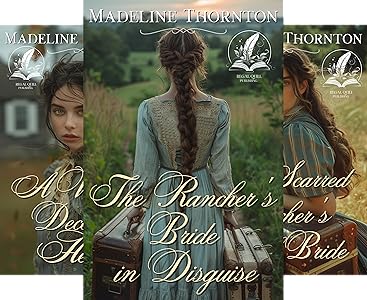

Chapter One
With a fortifying breath and a discreet swipe at the sweat layering her forehead, Celia Harper stepped off the stagecoach and out into what would be her new home.
For a moment, the sun blinded her. She put a hand to her brow for shade.
Before her, Ash Hollow spread like a picnic blanket in a field. As in, there was not much around.
An old man swept the sinking porch of the livery. A couple of boys kicked a can between them while a dog barked. One woman hung laundry on a crooked line between two tired houses. The man looked over her with little interest while the woman threw discreet glances between dangling shirts.
Self-consciously, Celia brushed the dust from her long, black mourning skirts. She imagined she would be doing that quite frequently from now on. Behind her, the coachman called to the ticket agent at the depot door.
Celia had been through many towns much like Ash Hollow and had never once considered she might settle in one. She peered down the fat stretch of dry, wheel-rutted dirt road. A barber shop faced a milliner, followed by what Celia suspected were some of the nicer houses in Ash Hollow.
Boards creaked, shutters rattled, and heat shimmered off the sunbaked earth. Celia adjusted the strap of her satchel. It was not so bad. She smiled at the boys, now arguing over whose turn it was. Now that was a familiar sight.
Assessing the storefronts around her, she was about to ask the ticket agent for directions when a sharp, frustrated cry cut through the quiet.
It was a child, she knew instinctively. The ticket agent and coachman paused in their conversation, but only briefly.
Celia frowned at the men, hesitating. She was a stranger here. But when the frustrated cries continued, she followed the sound to where it led just behind the depot.
A small girl sat on the ground, cheeks flushed, a wooden toy with a broken wheel clutched tightly in her hands. Celia knew with an expert eye she was short for her age. Perhaps around seven years old.
“This does look like a bad time,” said Celia, crouching down.
The girl scowled, tears welling in her eyes. She held up the broken wheel. “It won’t go back on.” She dropped her hands dejectedly. “So, I hit it. A few times. And it still won’t go back on!”
Celia smiled. “Didn’t your mama ever teach you that violence never solved anything?”
“Yeah, but my papa always said you need to show a rebellious thing that you’re tougher,” she said, making Celia’s eyebrows rise.
The little girl swiped the dark hair sticking to her cheeks. “I’m sorry. I don’t mean to be cross, but–” Her lips trembled. “My knee hurts something bad.”
“Oh dear. Can you show me?”
The girl nodded, eyebrows pinched. Lifting her dirt-streaked skirts, she revealed a badly scraped knee smeared with dirty blood.
“Oh honey,” Celia murmured. “Now that’s a wound fit for a soldier. And you survived it?”
Dark hair bounced as she nodded. “I’ve had worse, too. But always they–”
“Hazel Barnes!”
The little girl, Hazel, looked up, a guilty expression overshadowing her tears. “Here …”
A woman came briskly around the depot. Stopping short of Celia and Hazel on the ground, she planted her fists on her hips. She took a long look at Celia before turning to Hazel.
“Not only are you not where I left you, but you are talking to a stranger as well.”
Hazel’s eyes widened, suddenly free of the tears that had just been there. “She’s a very nice stranger. Her name is–” She looked at Celia then whispered, “What’s your name?”
Celia whispered back, “Mrs. Celia Harper.”
“This is Mrs. Celia Harper, and she’s the nicest stranger I have ever met.”
“Oh, yeah?” asked the woman. “And how many strangers do you go around meeting?”
Wisely, the little girl pinched her lips shut.
Standing, Celia held out her hand. “I am sorry for invading as I have. I am to be the new schoolteacher. Please, call me Celia.”
Celia heard a small gasp behind her.
With this new information, the woman reassessed Celia. Her manner was pragmatic but not cold. “Well then, I guess I have nothing to complain about. You’re just doing your job. And quite well, I might add.” The woman looked knowingly at Hazel. “You’ll have your hands full with this one.” Taking Celia’s hand in hers, she said, “I’m Mrs. Emma McAllister. It’s good to meet you.”
“You as well.” Celia looked back at Hazel, still sitting in the dirt in the shadow of the depot, her dress conveniently back over her legs. “I fear I am obligated to tell you, if you lift her skirts, you’ll find a mess of a scrape on your daughter’s knee.”
Emma sighed, glancing at Hazel. “She’s not mine, but the daughter of a friend. And I don’t doubt your words. Come, Hazel. And you too, Mrs. Celia Harper. You don’t yet have lodgings, do you?”
Celia obediently followed, Hazel lagging behind. “No, I’m afraid I just disembarked the stagecoach a few minutes ago.”
“Then you shall stay with us. The boarding house is only a few rooms big, and they happen to be occupied at the moment. We’ve had our share of strangers in these parts lately.”
“Oh, I could not possibly, I’m sure I can find accommodation elsewhere.”
Emma led them a short ways down the street and up the porch steps of what looked like a general store.
“I’m sure you could. There are plenty of accommodating folk in Ash Hollow. But now you will not need to. There’s a spare room upstairs. We won’t miss the space.”
In the face of such forceful kindheartedness, Celia smiled. “Then I would be happy to accept.”
Feeling a light tug on her dress, Celia glanced down to find Hazel looking up at her.
“You’re really going to be our new teacher?”
“I really am.”
Hazel did not smile but looked contemplative. “Are we going to start learning soon?”
“As soon as we can manage.”
Hazel nodded. “Alright. I only like school sometimes, but I think I like you. I’ll try to be good,” she promised. “Maybe even study some.”
“You seem wise and generous,” Celia said, resisting a laugh to protect the little girl’s dignity.
Entering the store, Hazel hopped onto a cowhide stool with a price tag on the leg. Emma went behind the counter, reappearing with a cloth and gauze in hand. With efficiency, she cleaned Hazel’s wound as the little girl squirmed and complained something fierce.
While her two companions were occupied, Celia looked around the store, noting the humble but sturdy products. A long line of shelves reached to the ceiling with every dry good one could need. The sales counter had a vase with some limp lilies. The back wall had a door leading to what Celia assumed would be the personal quarters.
Out the window, a breeze caught a tumbleweed, but the boys from earlier recaptured it, laughing. They chased each other out of view.
Putting the medical supplies away again, Emma looked at Celia. “Can I show you to your room?”
“Yes, please.”
Emma left Hazel in the front with instructions not to wander. The back door opened up into a small kitchen, which shared space with a small greeting room. Lacey curtains hung on the window, casting patterned shadows onto a pale couch. A narrow staircase led to a sweltering attic room with one unmade bed. Celia had to duck on her way in.
It was cramped accommodation, but Celia did not mind. As she was guided around, Emma explained she lived below with her Aunt Margaret, who owned the shop.
It did not escape Celia’s notice that though she had introduced herself as Mrs. McAllister, no mention of a husband had yet to be made.
Celia had expected to be staying at a boardinghouse with strangers until finding more permanent housing. It would be a relief to have private quarters with local residents. And more so, what she hoped might turn into a friend.
“We were not expecting you so soon. Mary, the previous teacher, lives out in the country with her new husband now. She’s not supposed to arrive for another day or so. The journey isn’t a short one. And that’s another reason she couldn’t keep up with the children’s education.”
“Yes, I bought an earlier ticket expecting as much. I wanted a day or two to acquaint myself with Ash Hollow before beginning. That won’t be a problem, will it?”
“I expect not,” Emma replied. “We’re simply glad to have you. The destruction of the school scared away the few applicants we had. The ad must have circulated for months before you answered.”
“Well, children are daunting enough. I can only imagine that fixing a few cracks in the schoolhouse itself will not make it easier.”
Emma looked at her with a raised brow. “A few cracks? I think someone may have misled you, Celia.”
“It was a thunderstorm that did it, is that not right? They said the windows had been cracked from lightning.”
“Yes, lightning cracked the windows and put a hole in the roof, which allowed for flooding. I’m afraid you have taken on quite the task.”
She hoped Emma was misunderstanding the damage. Celia was hardly qualified to do more than hammer in a nail. “I think I must see it for myself as soon as possible, then.”
“Well, they certainly can’t complain you’re a lazy one.” Emma laughed, causing Celia to smile. “I can give you directions. Do you have luggage? Hazel and I can collect it while you take a look around.”
Celia already knew better than to argue. “I have two trunks I left with the ticket agent, waiting to be picked up. You are very kind to offer.”
“Say nothing of it,” Emma replied.
The walk from the general store to the schoolroom was the perfect length. Short enough if she were running late, but long enough to give her a moment of peace before a busy day. The road outside the general store took her straight to the edge of town, where Emma said the schoolhouse would be.
She could see it in the distance, just as Emma had described. Small, with peeling yellow painted walls and a large oak out front.
As she drew nearer, the damage Emma warned her about also came into focus.
On the roof was a large, round area blackened with char. Celia did not have the experienced eye to gauge the depth of the damage, but it looked like days’ worth of hard work to her.
She took a breath. Days of hard work were not weeks of hard work.
Three of the windows were cracked. The bottom of the schoolroom, where the grass grew long, was rotting away.. It looked like a half-hearted attempt to preserve bookshelves had been made, as the shelves were sitting out in the yard, empty of books, faded with sun exposure.
It was certainly more than she had expected, and much more than she knew what to do with.
Suddenly, a wave of nausea hit Celia, weakening her knees. She took a seat on a small boulder, fighting faintness.
Her nerves must be overly taxed from the days of travel she had just endured; this weakness was not like her. The enormity of the responsibility she had accepted settled in. Worry compounded the turning of her stomach, making for a few uncomfortable minutes.
Celia sat still, allowing it to pass.
The discomfort soon went away, but Celia remained on her rock, observing the school as the sun began to sink behind it. The shadows around her stretched with the deepening orange glow.
The unsightly damage turned less intimidating with the change of light. Or maybe her eyesight was going with the sun. Either way, exhaustion dissipated into anticipation the longer she sat there.
She could do this. And once she did, she would have a place in this town. A new life.
The air grew cool, and without the discomfort of nausea, Celia felt refreshed.
Finally, Celia stood. She began to return to her new bedroom but hesitated. Out of her dress pocket, she pulled a small silver locket. It held a picture. The man in it was older, stern. His mouth was not smiling, but neither was it mean. Celia gazed at him with melancholy, a lonely fondness in her heart. She closed it with a soft click.
“This is my chance,” she said out loud, though only she could hear. She turned from the schoolyard to face the town. She was not prepared for the challenges ahead, but she would mend what needed mending anyways. She always did.
Chapter Two
Micah Thorne hated being their spectacle. He could feel Ash Hollow’s gaze on his back. A small crowd lingered, ostensibly to observe the new roan.
It was a fine horse with spirit in its flared nostrils, but it was not the reason they were here.
With one hand gripping the fence, Micah hopped from his perch, landing low in a cloud of dust. He maintained his lowered position, taking deliberate steps to the left.
His eyes never left the animal.
Likewise, the roan fixated on Micah, her hooves stamping violently at the ground.
He circled her slowly, his feet mimicking an ancient dance. This was why the people were here. Whether Micah was an oddity to them or a professional to respect, he would be gawked at regardless. No different from the roan.
He raised his hands, one at a time. His movements were gentle, free of surprise.
She swung her heavy haunches toward him, the threat visible in her coiled strength. People gasped, and she heard. Spinning in a tight circle, ears flat, she forced Micah back several steps. There were calls of worry from behind him.
Micah gritted his teeth at the interruption. Giving the roan a wide berth, he circled, positioning himself at the far end of the corral. The crowd was now a muted backdrop to the tension between Micah and the wild beast in front of him.
She was pawing the ground again. Micah took a bold step toward her, a gentle whisper on his breath.
Her head swung first one way, and then the other.
The roan was full of warning and fear, but she made no move toward him. She was listening.
“Do you hear my voice?” he asked the horse.
She snuffed.
Micah made sure her eyes were on him as he lowered his gaze. Head cocked down, he could see nothing except the disturbed sand between them.
“Can you still hear me?” He took a blind step forward, sending a wave of whispers through the crowd.
“Do not give them the attention they want,” he murmured. With another step, he relied on his instinct regarding the roan. She was frightened, but she was not out of control.
It was not a technique he would ever suggest to another man, but it was one he knew to work.
Step by step, he approached, unable to see her except in the periphery.
When rising speculation from the crowd threatened to distract the horse from him, Micah raised a hand. Miraculously, the people listened and quieted.
“Just you and me, brave one.”
He took one last, small step into her space. The roan’s lungs heaved with her restrained power. Even the crowd did not dare speak.
With his head still lowered and breath held, he leaned into her neck. Neither of them reacted.
After a few moments, Micah touched his fingers lightly to her shoulder in a stroke. One brief touch led to a longer one. He dared to brush her jaw.
He could feel her tail swish.
“Brave, brave,” he whispered. As her fragile trust allowed his soft touch, they settled into a truce. He would not push her further today.
Unable not to, he turned his head to the crowd to see their reaction.
Children were staring wide-eyed from behind their parents’ knees. A few stable hands conferred lowly off to the side, likely discussing his technique. One of the older ranch hands, Mason Reed was among them, but not with them. The man’s silent gaze always gave Micah a sense of discomfort.
But Reed was not the one to whom his eyes were drawn. Leaning against the tall corral post was a woman. A widow, from her black dress. With the lowering sun he could not make out her face, yet Micah knew with certainty he had never seen her before. His attention lingered there, thinking that in her mourning clothes, she stuck out as much as he did.
He stroked the horse’s neck, listening to her short breaths. Scared but steady.
Micah backed away, satisfied when the roan hesitantly followed. He encouraged her pursuit until his back hit the gate. The horse watched, head high, as he left her in the corral. The local residents began dispersing with hushed whispers, knowing enough to give the calmed horse her space.
Exhausted, Micah took his hat off and shook out his sweat-matted hair. He started to join the others on the way to the saloon but stopped short when he noticed a younger man staring openly at him.
Micah fought the urge to put the hat back on, knowing the dark coloring of his hair drew attention to the rest of his features. He glared instead, forcing the other man’s gaze away in embarrassment. Sometimes the white man’s irrational distrust of Natives was useful to him.
A hand slapped his shoulder, distracting him. Micah looked back, already knowing who was accosting him.
“You sure impressed them,” Jonas remarked.
Micah snorted. “Impressed, or invited their judgment?”
“They are jealous, Thorne. They may judge, but only because they could not gentle the beast themselves.”
Micah smiled despite himself. For a man who grew up alone, camaraderie was as unfamiliar to him as prayer on Sunday.
“Should we take her inside?” asked Jonas, referring to the roan.
“No, leave her be. She’ll appreciate sleeping in the corral tonight.” Micah looked toward the town again. “There was a woman here today. I think she was a widow, she was wearing black. Did you see her?”
“A widow in black? As far as I know there is none in town. Unless someone’s drunk himself to death, she must be new.” Jonas laughed, starting for the saloon.
“You’re probably right. With all the visitors we’ve gotten, she might be with any of them.”
“And there have been a suspicious few,” Jonas agreed. “You’ve got an eye for observation, Thorne. You’d make a good lawman.”
“You think something’s going on?”
“Something is always going on. How much we should care, that’s what needs to be determined.”
Micah looked at his friend, walking by his side. The sparse houses on the edge of town turned into tightly packed shops as he chose his next words carefully. “And yet you haven’t considered picking up the badge again?”
Jonas’s pace didn’t falter, but Micah sensed him stiffening.
“I don’t see any reason why I should,” he finally replied. “Ash Hollow has a sheriff already, and he’s a damned good one.”
Just then, Jonas and Micah entered the saloon, both nodding to the man slumped at the door with a pint in his hand and a dazed look in his eye. The saloon was packed already, the early suppers buzzing with conversation.
“There are other towns,” Micah said as they found an empty table in the back. “Ones sorely in need of an honest lawman.”
“You’ve been busy lately,” Jonas said, deliberately leaving the subject unfinished. “Have you been snooping around the courthouse records again?”
Micah sighed, knowing he had earned that invasive question after his own prying.
“No, I’ve been working. Horses don’t hibernate just so humans can take a day off. Besides, I never had any luck searching the records. Or at least what they would let me look at,” he finished in a grumble.
“So you’re no closer to finding–”
“No, I’m not,” Micah interrupted, annoyed.
Just then the barmaid brought them two pints of ale and some pan-fried beef, smiling at them both before quickly moving along. Micah poked the over-cooked meat, not feeling particularly hungry. “I told you, I’ve been working.”
“Working? I haven’t seen you in Lottie’s stables all week.”
“Not with Lottie’s horses. Kincaid has me up all hours with the foals. I swear that man is bringing a new stud in every week for breeding. Must be spending a fortune for their time.”
“Breeding?” Jonas scoffed. “It’s almost September!”
“You’re telling me, and I’ve been telling him. He’s gonna lose a mare if he doesn’t listen to reason real soon. But rich men don’t care much for the lives of the working man, much less a breeding horse. She’s money to him.”
“Greedy bastard,” muttered Jonas. “So, I’m guessing he’s looking to buy that filly you sweet-talked today?”
“Yeah. Fresh blood. But he would breed his mares again this year if he could.”
“Since I’ve been here, that man hasn’t once …”
Micah took a bite of his beef. It was as dry as it always was. Realizing Jonas’s sentence was never finished, he glanced up, curious.
Across many chattering heads at the entrance of the saloon, Emma McAllister stood tall, her hair an auburn halo lit from the window behind. She was talking to the barmaid, smiling at something the harried girl was saying.
Micah took another bite, chewing, watching his friend covertly watch the woman.
“Hasn’t once what?” he prompted.
Jonas looked at him. “What?”
“You were saying something about Kincaid.”
“Must not have been important,” Jonas muttered, ripping off a bite of his own stale beef.
“Not as important as a pretty shade of red, at least.”
Jonas’s gaze sharpened on Micah. “I don’t know what you mean.”
“Yeah, you do. The woman’s husband is dead. By many years, I hear.”
“And what does that matter to me?” Jonas demanded, but Micah noticed he did not ask what woman he was talking about.
“Well, you wouldn’t want to be eyeing a woman with a live husband. Bad for the heart, might end up with a bullet in it.”
“If I wanted a woman, I would go and find one. They’re everywhere, and they happen to like me. I don’t need a lonely bastard like yourself advising me on how best to–”
“Excuse me, Mr. Holt,” murmured Emma as she squeezed past their table.
“Ma’am,” replied Jonas, posture suddenly improved, voice oddly low.
Her eyes found Jonas’s before they each looked away.
As her skirts disappeared into the crowd, their table remained quiet. Micah waited for his friend to straighten himself out on the inside.
Finally, Jonas sighed, lifting his glass. “To the working man.”
“And the breeding horse,” Micah added, clinking it with his own.
The men sipped in silence. Micah knew Jonas was thinking about the subjects he didn’t want to speak of yet. Remembering Jonas’s inquiry about his search, Micah found himself doing the same.
Chapter 3
The smell of fresh bread woke her, but the comfort of it kept her in bed.
Celia had been lying beneath the covers, enjoying the sort of time that was immeasurable. She imagined this was what children felt like, bundled safely under the aroma of their mother’s cooking.
Sitting up, Celia shook herself awake. Her courses must be coming soon, there was no other reason to feel so powerfully over the sweet smell of warm bread.
Finally convincing herself to rise, she chose a dark mourning dress for the day, although there truly wasn’t much of a choice. It was modest, as most clothes tended to be for schoolteachers.
She found Emma where she expected to find her: in front of the wood-burning stove, a plate of eggs already on the table.
“Welcome to the land of up and at ’em, Mrs. Celia Harper.”
Celia smiled. “Good morning, Emma. This isn’t for me, is it?”
“It is now, since you’ve gone and stuck your fingers in it.”
Celia spun around to see a stout older woman adding another plate to the table. She wore a cream apron with little flowers embroidered into it. Although her hair was in a bun, several frazzled silver hairs framed her face.
“Forgive me!” Celia cried, her hand in front of her full mouth, embarrassed.
“Never apologize for something you needn’t,” the woman said, her eyes serious, yet teasing. “What’s mine is Emma’s, and what’s Emma’s always seems to be shared without reservation. I’m Margaret Hanley, but to you, I’m Aunt Margaret. And I’m willing to bet you are Mrs. Celia, Ash Hollow’s newest schoolteacher.”
Celia swallowed her bite. “You are right. Are you often a betting woman, Aunt Margaret?”
Margaret slapped down three cloth napkins onto the doily tablecloth, one right after the other. “You better bet I am.”
“You better not bet against her, either,” Emma added from the stove. “Richer women have tried.”
“It’s a good thing I’m not much of a betting woman, myself,” Celia responded. “I’m afraid I’m not quite as exciting as all that.”
“No, you seem a smart one. I can tell. Nothing wrong with being cautious,” said Margaret, handing her a glass of milk.
“Thank you.” Celia looked at the milk, then up at the women bustling around the kitchen, paying her no mind except to ask how many eggs she thought she might eat.
“Three,” she answered, her voice suddenly small. “May I step outside for a moment?”
“There are no laws against it, far as I know,” said Emma.
Entering into the crisp morning air, Celia breathed out a long breath. It was her stomach again, rebelling against the smell of eggs when it had just been begging for them a moment ago.
Celia put a hand to her face, hoping she wasn’t coming down sick.
Just then a rider came into view. Celia averted her gaze, still getting over her sour stomach and trying not to appear like she was staring.
But she was. Celia recognized the man as the trainer who had gentled the wild horse yesterday.
On her way back from the schoolyard, she had stopped to see what everyone was gawking at, but she had stayed because she saw what they did. The man was a master at his craft. The way he moved, the way he had communicated with that scared horse – it was without misstep. And the way he had held the animal after …
Celia had found him compelling.
Now, he looked like any other man riding leisurely through town. Hat low, boots scuffed, and shirt alive with the wind. He had strong, serious features. She wanted a closer look.
She glanced away prudently, but her resistance only lasted a second.
He had stopped at the community’s well, not so far from the porch of the general store. One arm over the other, he drew the rope up until the bucket appeared. He tipped the fresh water into the trough for his horse. He must have felt her gaze as he waited patiently for the beast to have his drink because he looked up directly at her.
Celia’s face reddened, and she glanced toward her hands, immediately angling away. She saw out of the corner of her eye how the man politely did the same.
It was too late for her to run inside now, so she pretended to busy herself with her thoughts.
Chancing one last peek at him, she found the man’s eyes on her. This time he did not look away, but held her gaze for a nerve-wracking moment, before tipping his hat to her.
She waited, heart thundering as he readied his horse and began trotting away.
Celia put her fingers to her mouth, and this time it had nothing to do with nausea. A certain excitement shot through her, only to be overwhelmed immediately by a familiar guilt. She was a widow, and she was acting like one of her students!
But a moment later, a smile came to her lips, regardless of her conflicting feelings.
She headed back inside, her upset stomach entirely forgotten.
“Is there something I might do to help?” she asked the room, hoping to make use of her nervous energy.
“Yes,” said Emma, two hands on the butter churn, sleeves rolled up. “You can sit and tell us where you came from. Was it very far away?”
By the time the butter had been churned and all the eggs eaten, Celia didn’t have many secrets left. The ladies had not shied away from any questions; their curiosity about the new schoolteacher unending.
Yes, she had grown up in Millsberg. No, it was not near the Pederson Ranch. Yes, she had spent many years working with children. No, she had never broken a bone, arm or otherwise.
Yes, her husband had recently passed away.
The pointed reminder so soon after her shocking reaction to the horse trainer only served to further drive in the guilt.
“His name was Richard. He was the sheriff in Millsberg. He was … a good man.” Celia wrapped her hands further around the glass of milk. It had only been a few months now, and they hadn’t been easy.
“That is why I am here. Ash Hollow will be my new home.” Feeling a hand on hers, Celia looked up into Emma’s clear eyes. She found empathy there. “No cracks in the schoolhouse windows are going to change my mind.”
Emma smiled, squeezing her hand before letting go. “I didn’t suspect they would.”
Emma stood, clearing the dishes away with Margaret’s help. “Come now, we have a town to meet. Are you ready?”
“Yes. Yes, I believe I am,” Celia answered, knowing Emma was not asking an idle question. She sensed a unique understanding, and her curiosity about the other woman grew.
Walking past the bank, Celia was just admiring its older architecture, the only building in town that seemed to have any stylistic intentions, when Emma pulled her to the side. They were swallowed by the shadows of the bank’s oversized columns.
“Do you see that man walking out of the deputy’s office?” she asked, voice low. “That is Mayor Aldrich. His wife left him years ago, and he is infamously–”
“Mrs. McAllister.”
Emma spun around, “Mayor!” With a stiff smile, she introduced Celia.
“Ah! Our new schoolteacher, Mrs. Harper. We were not expecting you so soon. But it seems you’re all settled with Emma here, already.” He shook Celia’s hand, his chin bouncing with the fervor of it. Celia retracted her hand from his sweaty embrace as soon as she was allowed. “I see I must extend my condolences, too. I was not aware your husband had passed when you accepted our ad. You are in mourning, are you not?”
The audacity of the question did not offend Celia so much as catch her off guard. “I – well, yes. Recently. Very recently.”
“Ah, that is too bad. My wife departed many years ago, too. I can sympathize, yes, I can sympathize.”
“Thank you,” was all Celia could think to say.
“And you probably haven’t even met Mary yet. She just made it into town this morning. I saw her in the church’s literary room only a little bit ago. If I may–”
“My! We were just on our way there. Thank you, Mayor. If you’ll excuse us, you have been a great source of direction.”
Aldrich’s cheery smile melted into something less pleased in the face of Emma’s interruption.
“Of course,” he muttered. He turned a smile back on Celia. “It was a pleasure making your acquaintance, Mrs. Harper.”
“And yours.” The words barely left her before Emma was dragging her away.
“Emma!” Celia whispered, laughing.
“Do not listen to a word that man says. His wife left him, and he has been looking to replace her ever since.”
“He claims she departed!”
“She did. Loudly. And legally, he is still married.”
Celia’s mood was bright as they made their way into a humble room off the side of the church. Inside, a small collection of bookshelves filled with primers and devotionals was lit by the sunlight seeping in through the windows.
“Oh,” Celia murmured. “Now this is a blessing.”
“Yes. What books could be salvaged, were. And they came here. You see the woman in blue? That is Mrs. Mary Newman, the former schoolteacher.”
Picking Mary Newman out of the four women sharing the quaint space was not a difficult task. The sparse correspondence with the town council had mentioned the former teacher had become pregnant, but the actual breadth of her stomach was somewhat shocking.
“I see.”
Emma took Celia’s hand, leading her forward. “Mrs. Newman.”
The woman looked up, curls bouncing around a rounded face. She was older than Celia. Older than Emma, too, which would put her in her early thirties. “Emma McAllister.” She smiled.
“I would like you to meet my new friend …” Celia caught the word, feeling a spark of pleasure, “ … Mrs. Celia Harper.”
“Oh!” The book Mrs. Newman held closed with a snap.” She struggled into a stand, disregarding any protests. The three other women in the room observed the meeting from sly glances behind their own books.
Taking Celia’s hand in both of hers, she shook. “My replacement!”
“Oh, I do not think I could …”
“Nonsense! We as people improve, Mrs. Harper, that is what we do. And with my guidance,” she leaned forward, a smirk on her lips, “you will be the best we’ve had yet.”
Celia was given no choice but to agree. “Then I cannot wait,” she said with a smile.
“Yes, you can. You must, for I’m afraid I’m rather slow these days, and I insist on accompanying you to the school. And call me Mary.”
Mary was not willing to listen to anyone’s suggestion to the contrary, so Emma and Celia each took their place on either side of her as they slowly ambled toward the schoolyard.
As gradual as the walk was, it was hardly without energy. Mary had enough to spare. Neither Emma nor Celia could get much of a word in besides quick grunts of agreement. Mary elaborated on the storm that had put the school out of commission. She explained that the children had not attended since May, since she had been in no condition to fix anything at the moment. Even less so now.
“I’m not sure I understand one thing. Why did the town not help at all? The schoolhouse should have been a priority. It is their children.”
“Ah. Do not judge us too harshly. Many of us have been having rough times. Not enough daylight, or money. My husband is a rancher; he inherited a good chunk of land from his family, but with all this cattle thieving going on … We’re tired, Mrs. Harper. Bart Kincaid has offered us a generous price, but my husband wants to hold on. It is his family’s land, after all.”
“I’m sorry to hear that,” Celia said, her sympathy going out to the other woman. “I will do what I can for the children.”
“I’m sure you will,” Mary agreed as they approached the school. Pulling a key from her pocket, she unlocked the door, allowing the other women to help her inside.
Dust coated every surface. Desks were knocked over, and some legs broken off. The blackboard hung from one hook, its far corner crumpled with the impact of hitting the floor. Several floorboards appeared brittle, almost wrinkled.
“Well,” said Celia. “At least there are walls.”
“The Lord doth bless,” Mary agreed from where she had found a somewhat clean chair. She began listing all the injuries the schoolhouse had sustained, and the list was not a small one.
Finally, Mary held out her hand, the key in her palm. “I believe this is yours, now.”
Celia took the key, looking at it. Wrapping it in her fist she took a breath and smiled at Mary. “Come by tomorrow, I’ll have it all in order by then.”
“What a miracle that would be!” Mary laughed as Emma helped her to her feet again. “I’m afraid I don’t have much energy to continue for the day. Forgive me, but I will be by again, of course. Please let me know if there is anything I can do to help.”
“Of course.”
Unable to let Mary make the trek back to the church alone, Emma accompanied her, leaving Celia alone in the schoolhouse.
Or so they thought.
Celia had only carried a few chairs outside when she heard the whispering.
It was not subtle, though she suspected it was meant to be. Celia listened for a minute before walking over to the outdoor bookshelf, peeking over. Four sets of wide eyes stared back at her.
“Hazel Barnes?”
The three other children with Hazel, two boys and a little girl, backed away.
Hazel tugged one of her braids. “We’re just wanting to help,” she muttered.
Celia doubted that very much. “Well then,” Celia said smiling. “Let’s get to work, shall we?”
Hazel looked at one of the boys. The boy looked behind him to the second girl’s furrowed brow before nodding back at Hazel.
Hazel turned to Celia. She pursed her lips. “Alright. What are you needing?”
Celia’s heart was warm as her four little helpers followed her inside. She had always loved children, and this group was turning out to be interesting indeed. As the little people poked curiously around their destroyed school, Celia’s gaze was drawn outside.
A man stood at the edge of the road. His blond hair was faded with age, his jacket of the highest quality. It was clear handsome younger years had mellowed into distinguished older ones. Celia did not recognize him. His head was tilted toward the book in his hand, but Celia thought his eyes might be on the schoolhouse.
Celia put a firm hand on Hazel’s shoulder, restraining her before she could drag a chair outside. “Do you recognize that man?”
Hazel looked to where she indicated.
“Oh, that’s Mr. Kincaid, the rancher. He’s something rich. You’ll be wanting to know him if you’re gonna be in this town.”
“Perhaps,” Celia said, watching him. “No, don’t bother with the chairs now. Stay inside for the moment. There are some old rags in the corner. Why don’t you start dusting?”
Celia took one more look at the lingering man. Maybe he was just as curious as the children about the new schoolteacher, she thought, shutting the door firmly.
OFFER: A BRAND NEW SERIES AND 2 FREEBIES FOR YOU!
Grab my new series, "Whispers of the Western Wind", and get 2 FREE novels as a gift! Have a look here!
Hello my dears, I hope you enjoyed the preview! I will be waiting for your comments here. Thank you 🙂